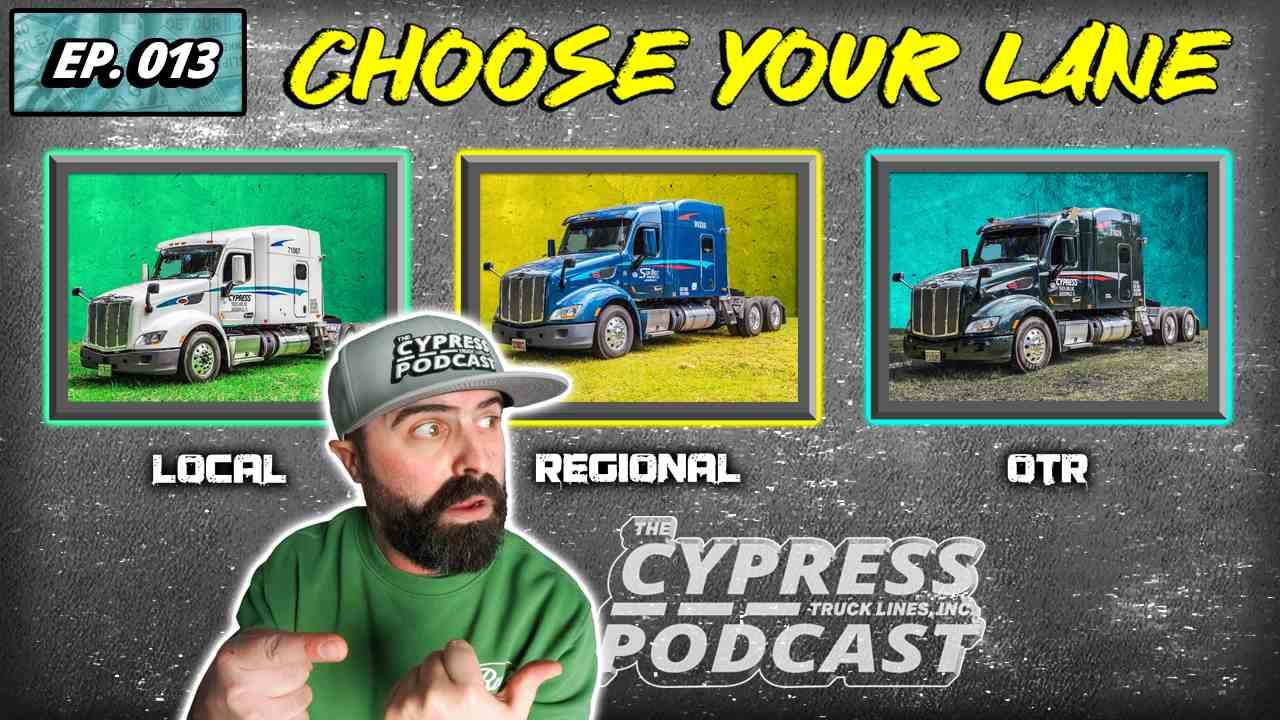
OTR, Regional or Local: Which Trucking Lane Is Yours?
Released 04/01/2026
Ready to play
00:00 / 00:00
00:0000:00
Episode description
OTR, Regional, or Local, it's the question every new CDL holder asks, and almost nobody answers straight, until now. In Episode 13 of the Cypress Truck Lines Podcast, we brought in three Cypress drivers who live in each lane every single day to break it down for you the right way. Kevin Barritt runs OTR. Brad Hollinger runs Local. John Weideman runs Regional. Together, they walk you through schedules, home time, earning potential, the biggest challenges in each lane, and most importantly, what drove each of them to choose the path they're on. This is the episode that drivers finishing up at Cypress CDL School need before orientation even starts, and it's essential listening for anyone who's CDL-curious and trying to figure out where flatbed trucking fits into their life. The first 90 days behind the wheel look very different depending on which lane you choose, knowing that going in changes everything. Whether you're eyeing the open road or trying to be home every night, this conversation gives you the insider information to make the right call for you. New episodes drop every Wednesday. Subscribe now and never miss a mile.
Every new CDL holder asks the same question and almost nobody answers it straight. OTR, Regional, or Local, which lane is actually right for you? Marcus went into this episode expecting a friendly rivalry. Three drivers, three lanes, three egos defending their turf. That's not what happened. Not even close.
In Episode 13 of the Cypress Truck Lines Podcast, Kevin Barritt, Brad Hollinger, and John Weideman, three Cypress drivers with years of real experience in each lane, sat down together and just told the truth. No debate. No trash talk. No trying to win. Just three guys who've been doing this long enough to know that there is no best lane. There's only the lane that fits your life. Schedules, home time, earnings, the biggest challenges, the trade-offs, and the real reasons behind each of their choices, it's all here. If you're trying to figure out where you fit in this industry, Marcus said it best going in: this might be the most important episode you ever hear.
Episode Highlights
Nobody tried to win: Going in, Marcus expected a sibling rivalry, the OTR guy calling the local guy short range Ricky, the local guy calling the OTR guy a super trucker, and the regional guy stuck in the middle making fun of both. What happened instead was the opposite. Every driver respected every other lane. Kevin said if local works for you, go for it. Brad acknowledged they're all dealing with the same risks just in different forms. John nodded at both ends and said yeah, I deal with a little of all of that. That mutual respect is the episode's most surprising and most valuable moment.
Same challenges, different varieties: Brad put it simply and it stuck, same challenges, same responsibility, same risk just different varieties of it. Local deals with traffic and congestion all day. OTR deals with time management, parking, and being away from home. Regional deals with a bit of both. None of it is easier. All of it requires the same core skill, getting the load where it needs to go safely, on time, and efficiently. The lane doesn't change the job. It changes the lifestyle around the job.
Home time. The real deciding factor: More than earnings, more than miles, more than anything else discussed in this episode, home time is what separates the three lanes and ultimately what drives most drivers toward one over the others. Local means home every night. Regional means weekends home with some time out on the road. OTR means going all in maximizing miles and earnings in exchange for extended time away. None of these is the wrong answer. They're just different answers to the same question: what kind of life do you want to live?
The money conversation: Nobody called their lane the golden ticket. What you heard instead was a conversation about efficiency, how you run your day, how you manage your time, and how those habits separate drivers regardless of which lane they're in. The earning potential exists in all three. The drivers who maximize it aren't the ones who picked the right lane. They're the ones who figured out how to run their lane the right way.
Final word: balance When Marcus asked Brad for his final thoughts, he didn't talk about miles or money or traffic. He talked about balance, between hard work, family life, and learning as you go. He talked about still having things to learn from drivers who've been doing this longer than him. And he talked about the reward of passing that knowledge on to newer drivers coming up through training. One word that summed up an hour-long conversation perfectly.
From The Host
“I came into this one expecting some friendly fire and got something I didn't see coming, three guys with zero interest in proving anything and complete interest in just being honest. Kevin, Brad, and John sat there for almost an hour and nobody once tried to sell you on their lane. What they did instead was give you the information you actually need to make the right call for yourself. And that's harder to do than it sounds. Don't ask which lane is best. Ask what kind of life do you want to live. Brad found his. John found his. Kevin found his. And all three of those lifestyles look completely different. There's a lane at Cypress for you, you just have to figure out which one it is.” — Marcus Bridges, Host
Transcript
Expand to read the full episode transcript.
speaker-0 (00:00.92)
You know, going into this episode, I thought I knew exactly how the conversation was gonna go. We bring on an OTR driver, a regional driver, and a local driver. We give them 10 or 15 minutes before the OTR guy calls the local guy short range Ricky, and the local guy calls the OTR guy a super trucker. Meanwhile, the regional trucker just kinda sits there like the middle child and makes fun of and supports both of the other ones.
Yeah, but my lane's tougher. No, my lane's tougher. That didn't happen at all. That's because if you've been around trucking like I have and just kind of around, it's four years for me making podcasts for truckers. You'll know that this debate shows up a lot, but that is, like I said, not what happened here. It's not even close. What we got instead was three drivers who've spent real time in this industry. And instead of arguing about whose lane was better or worse, they just told the truth. That every lane has its challenges, every lane has its trade-offs, and more importantly, every lane works for the right person. So today, the episode isn't about proving which lane is the best. This is about understanding the differences between those lanes from the people actually doing the job every single day. Because if you're trying to figure out where you fit in this industry, this might be the most important episode that you're ever going to hear.
Let's get to it.
speaker- Intro (01:27.438)
Countdown to the Cypress Truck Lines Podcast starts now.
Your number one professional flatbedding podcast here to deliver stories, safety updates, and company news directly to your ears. Let's get down to business.
speaker-0 (01:57.784)
How's the weather out there Cypress and Sunbelt welcome into the Cypress truck lines podcast I'm your host Marcus as always thank you kindly for clicking download on today's episode we've got a doozy of an interview coming up for you here almost a complete hour with three Cypress and Sunbelt drivers and we are going to talk about the differences between OTR regional and local and we're gonna break it down
like you've never heard before. This comes directly from the horse's mouth. Three guys that have a lot of experience. We're not just talking months here. We're talking years over years of experience driving in the lanes that they're driving in. And I can't wait to welcome them to the show because I think that you're going to be surprised at how this conversation goes. I honestly kind of expected a little bit of a sibling rivalry type conversation here, but really that wasn't what happened. I'm gonna go ahead and save the rest of it, because I already gave you a little bit in the open, the cold open there. I gave away a little bit of what happened. I don't wanna give away anymore here in the intro. So I'm gonna clam up about it, but just know that as soon as this intro is over, you're gonna get one of the most informative interviews that we've had here on the Cypress Truck Lines podcast, and pay special attention.
If you are a Cypress or Sunbelt driver out there thinking about changing lanes, maybe you're a regional guy thinking about going local so you can get home more. Maybe you're a local guy that yeah, being home every night is nice, but I want to earn the big bucks. And you're thinking about going OTR. At the end of today's episode, you will have all the information that you need and more from these three gentlemen that are joining us. So make sure you stay tuned. And honestly, we don't have that much time for the intro here anyway, because like I said,
The interview went almost a full hour and there's nothing that we're cutting out of it. It was awesome. So without further ado, let's talk about the homework. You guys all have a homework assignment every single week here on the Cypress Truck Lines podcast. And it's a real simple one. In fact, most of you have already completed the assignment, I'm guessing. but there's some of you out there that still haven't done it yet. And it's simple. All you gotta do is go to a web browser, whether it's on your phone or your tablet or your computer and type in the word podcast dot Cypress truck dot com. It's that simple. That's our website. That's what we call our landing page for the podcast. Everything about this podcast goes up there for your convenience. Now you can find this podcast at Spotify or I heart or Apple. Absolutely. We're there every single episode at the exact same time that it drops on the website. But if you'd rather just go to your company's website and kind of live in that environment where we'll have all sorts of interactive stuff that you can do there. You can check out the description of every single episode that we've had, find out who's in it, find out what we're talking about, select which episodes you want to listen to. As we produce more and more and more episodes for you, we'll start to put those into playlists on the podcast website. We'll get some metrics up there from time to time. If there's photo galleries or pictures that people have sent in that correspond with certain episodes, they're up there right now. You can go see that beautiful sky shot of the certainty plant out in Palatka. That's one of my favorite pictures. I love a good drone shot, really give you the scope of an area that you're working with. You can find all of that stuff online at podcast.cypresstruck.com. And I'll be honest with you. Most of you guys are going to the website to listen rather than listening from, you know, Spotify or Apple or any of those. So you're liking the website.
My guy Tyler's the guy that's responsible for it. He's going to keep doing his good work and we're going to keep putting stuff up there for you. So bookmark the website today. That's the homework assignment podcast.cypress truck.com. And I also want you to listen towards the end of our upcoming interview here. One of the drivers that joins us next up here on the Cypress Truck Lines podcast actually suggested this topic to me. I didn't come up with this.
My producer didn't come up with it. My audio ninja, Mike, wasn't him. Tyler, the web guy, it wasn't him. This came directly from a Cypress driver. And he said, Hey, I think this would be a cool episode so that other drivers can kind of, you know, hear somebody driving in that lane, talking about the job and see if maybe it's right for them. And I thought that was a phenomenal idea. So you'll hear me thank him, but you'll also hear me in the end of this interview, ask him.
How easy was it to get in touch with me and suggest an episode and how long did it take to get the whole thing done and we're finishing up? I think you'll be surprised. Okay. It's really simple to get in touch with me. All you got to do is go over to that website, podcast.cypresstruck.com. It's a one click from there and you're in my inbox. And on top of that, my phone number is floating around the ranks there at Cypress. If there's been anybody on this podcast before, they will have my cell phone number or my email address, either one, you can get it from them. So all I'm asking is connect with me. I'm one of those guys that, you know, I'm super friendly. I seem to be nice to everybody, but I don't have the friends yet because I just got here. I'm starting to get some friends. I'm starting to, we're starting to pile them in drivers that have come on the show a couple of times, people that are reaching out to me. It's awesome.
I want it to be even better so that we can talk to every one of you guys that works at Cypress or Sunbelt, regardless of what your actual job title is. If you're a driver, great. If you're in the office, great. If you're in the shop, great. Orientation, great. Training, great. CTC, great. We'll talk to every single one of you and you can get in touch with me by heading over to podcast.cypresstruck.com. That's the end of the homework for today.
I gotta clear the way here because we've got some great content coming for you. Please welcome to the show my next three drivers, an OTR, a regional, and a local to tell you about the gig.
speaker-0 (08:11.5)
All right, welcome back into the Cypress Truck Lines podcast. They got three drivers hanging on right now, waiting to come on and talk to me about the subtle and not so subtle differences between three different lanes of driving. We've got an OTR driver, we've got a regional driver, and we've got a local driver. And we are going to get down to brass tacks here and find out exactly what separates these three lanes aside from just the distance we're driving.
So joining me first is the gentleman that actually recommended this episode and I want to give him his props. We got Kevin Barritt on the line. He's our OTR representative. Out there over the road a lot. Kevin, thank you for joining us today, man. This is a great idea and I'm really glad you suggested it.
speaker-2 (08:54.126)
It's a pleasure Marcus, I was always happy to come on in.
speaker-0 (08:57.314)
Well, we're glad to have you fresh off of a week visiting some colleges, I understand.
speaker-2 (09:02.914)
my daughter is looking at colleges so we had to go up into Cedarville, Ohio and it was a it was a nice campus but my daughter decided that wasn't for her I think a lot of her had to do with the cold weather but what it is.
speaker-0 (09:15.234)
I understand. Now working for Cypress, is there a chance you're gonna get her down there to Gainesville or one of those nice schools down there in the warm weather?
speaker-2 (09:25.474)
No, Not a fan of games though.
speaker-0 (09:31.254)
Okay, I understand that. Well, I can recommend one very nice university that's a long way away from home. It's the University of Oregon. Go Ducks. That's my alma mater. So if you want to ship her across the country, that one comes with high marks from me if you don't mind the out of state tuition, Kevin.
speaker-2 (09:47.906)
Yeah, all right.
speaker-0 (09:49.778)
Yeah, he didn't like that suggestion either and I understand man. Next up to the show, Kevin by the way, we're glad to have you back man, always love to have you on the show, thanks for being here. Next up joining me making his first appearance is our regional driver, John Weideman. John, thank you so much for being here my friend.
speaker-3 (10:09.966)
Thank you for having me. It's my pleasure to be able to talk to you little bit.
speaker-0 (10:13.258)
Absolutely. Now we've already introduced Kevin to the audience here, so I didn't go with these next couple of questions here that I've got for you. But just so we know who we're talking to here, how long have you been working for Cypress, John?
speaker-3 (10:25.912)
I've been working for nine and a half years now and that's the only company I've worked for, Matter of fact.
speaker-0 (10:31.232)
Okay. So we found a home here. We're pretty happy. It sounds like.
speaker-3 (10:34.794)
I do like you it here, yes.
speaker-0
Okay. And, John real quick, do you have, experience with either OTR or local driving as well as regional where you're at now?
speaker-3 (10:44.142)
I've been regional the whole time I've been with Cypress, but I have gotten out a little further than a regional driver once in a while, so it's kind of nice to get out of this up a little bit once in a while.
speaker-0 (10:56.546)
Good, good. Well, I like that we've got somebody with a ton of experience regionally so you can really talk us through what that lane involves. John, thank you so much for being here. Joining us third here on the show today, we've got our local driver representative, Brad Hollinger. Brad, great to have you here, man. Thanks for being here.
speaker-4 (11:15.276)
Well, thank you for including me.
speaker-0 (11:17.032)
Absolutely. Now Brad, how long have you been on with Cypress?
speaker-4 (11:20.814)
Right about four and a half years.
speaker-0 (11:22.86)
Okay, so we've got some good experience there as well and have you been local the whole time?
speaker-4 (11:27.266)
the whole time.
speaker-0
Awesome, that's great man. And Kevin, guess I should ask you that question too man. OTR the whole time you've been with Cypress?
speaker-2 (11:35.534)
No, I started out as a home weekend guy, know, with regional Southeast. then as we you found out in the last time I was on with you that I enjoyed making money. So all the time was not a consideration for me. They had to they had to make a lot of change. And so they had to make up the recap just so I could keep running.
speaker-0 (12:00.366)
Right, right, okay. Well, then let's just jump in here and Kevin, since I'm on with you right now, I'll go ahead and ask you this question first, but Brad and John, this question's coming to you too, so be thinking about it here. Walk me through a typical day, Kevin, from the moment you wake up to the moment you're done. What's a typical day OTR look like for you, my friend?
speaker-2 (12:23.182)
I mean, across the three, let's probably get about the same answer. But I mean, the name of the game is to get them or get started early so we can get done early because earlier you start in the morning, the less traffic you're going to deal with and you're not so rushed trying to make your deliveries on, you know, OTR we get a little bit of more drive time available so we don't have to be in such a rush, but we still have to make our delivery time. So I usually I still trying to start at like two in the morning will be done by two, three o'clock in the afternoon. And sometimes that's even too late for me because I like to get better even earlier.
speaker-0 (12:59.032)
Sure. Sure, does it does it blow you away at all to tell you that I could easily still be up watching Netflix and not staying up too late out here in Oregon when you're actually starting your day on the East Coast that's wild to me because you know 11 o'clock like that's getting close to my bedtime, but I'm not staying up too late I'm not cheating anybody on the on the sleeping hours there. You're starting really early, man.
speaker-2 (13:23.662)
Yep, well, the two o'clock is kind of late for me. would do anywhere between midnight and two. I like to get started.
speaker-0 (13:30.638)
That's crazy. So some days you'll be starting before I even finish a late dinner. That's nuts to me. I like it though. It's because, hey, start early, get done early. That's managing your time. John, I'm going to come to you as our regional representative, walk me through a typical day because you have some of the same trappings of your day that Kevin's going to have, but also probably not as many of those, you know.
I don't know about parking for you, like talk me through some of the ways that you manage your day, John, and some of the things that you might have to consider that maybe an OTR driver would consider, but maybe not a local driver.
speaker-3 (14:08.302)
Well, the nice part about it is that there is some flexibility on when we want to start our workday. And I'm kind of like Kevin, I do like to start early, but I don't start that early. I like to start maybe around three or four o'clock in the morning. Okay. Because then I can get some time driving if I'm near a congested city and then I won't have to deal with the traffic as much. But the big reason why I start that early is for the same reason as Kevin is that we end our day, our driving day early. And due to the fact that theres so many other truckers on the road if you try to find a parking spot for your ten hour break any time past 5pm you're going to be sometimes struggling to find a parking spot. So if I can end my day at 3 or 4 o'clock in the afternoon its usually pretty decent for me to find a place for a 10 hour break.
speaker-0 (14:59.586)
Sure, well and that was gonna be one of my big questions there was the parking and really what time are you guys trying to get there before? And it sounds like for you, John, five o'clock is kind of that cutoff. You know if you get there before five, you're gonna find a spot, but if you get there after, you might be looking.
speaker-3 (15:16.343)
Yeah. Yeah, depends on the place, but some places are constantly full and some are reasonable. But generally, I try to find a spot before five.
speaker-0 (15:25.752)
Kevin, what's that clock in your head look like as far as trying to find a parking spot? I know it's a huge problem out there. There's not enough spots for everybody. What time are you trying to get in? Obviously starting your day a little bit earlier, you might not have this problem quite as much.
speaker-2 (15:39.854)
Yeah. Like John, four or five o'clock is like the sweet spot because any later than that. Like, you're fighting for parking and then you're going to be fighting for a shower when you get in there because everybody, when they shut down, first thing they want to do is go get a shower. Now you're sitting for two hours late on a shower when you could have been, you know, if you'd have shut down two, three hours earlier, you're in and out and you're in bed so can get up early.
speaker-0 (16:05.75)
Exactly. Okay. Interesting stuff there now. Brad, we're going to come to you and I know that parking might not be as big of an issue for you, my friend. Can you walk me through what a typical day as a local driver looks like?
speaker-4(16:19.106)
Well, completely different from what you've already heard. Completely different. It's more like a real day job. Parking is not an issue. Hours is not an issue. In fact, I don't even think about either one. Because I get to work a little before seven in the morning each day. And I'm usually done anywhere between three, four, five, and at the latest 6 PM each day.
speaker-0 (16:44.822)
Okay, and how many drops are you making per day in there, Brad?
speaker-4 (16:50.67)
It varies.So, we will get stuff from the ports. We'll do local building material deliveries. We may go get lumber. We may pick up drop loads and deliver them. We may live load. It's almost everything and every day is a little bit different.
speaker-0 (17:11.946)
Interesting. So my next question, kind of piggybacking on that, would be which one of you guys do you think has the most predictable schedule? Because Brad, when I was talking to you, kind of setting this up, you were telling me about, you know, times that you would be available. And that was kind of the impression that I got is that as a local driver, you might not really dictate your schedule as much as say Kevin or even John can really kind of trick plan, figure out where they're going to be and when.
You're kind of at the mercy of the court here, it sounds like.
speaker-4 (17:43.468)
Yeah, in fact, I was off today, so that made it a little bit easier. If I was, you know, working today, it would have been harder to tell you that.
speaker-0 (17:52.088)
Sure, sure. Okay, so Kevin, as far as most predictable schedule, I don't know if, I mean, I know that even OTR schedule can be unpredictable because sometimes you've got a load and you don't quite know what the next one's gonna be, but talk to me about the predictability of an OTR driver's job.
speaker-2 (18:13.518)
Well, predictability, it depends on basically where I'm at. If they send me out, way out, like south Texas, know, then I have no idea where they're gonna send me after that, because when availability of loads and how long it's gonna take me to get there, and what I got for hours. So, I mean, I'm kind of at the mercy of dispatch when I go too far out. Well, the southeast is kind of back to back.
If I go into the Carolinas, I know I'm going to go to either here or there. I can kind of predict it, But, most of the time, we'll say, we got this load. When do you think we can be there? I give them a rough estimate. Finish this. Well, when you get unloaded, we'll tell you where you're going next. So it's always a surprise where I'm going next most of the time.
speaker-0 (18:59.2)
Okay, so sort of unpredictable on the OTR side, too. That makes me curious, John, as far as regional is concerned, how predictable are your schedules or your weeks?
speaker-3 (19:11.522)
They can be very predictable, but they can also be a problem. So the big problem is, for instance, if you go to pick up your load at a gypsum plant, generally, your load may not be ready. And you might be there up to five hours. I've been sitting around waiting for my load to show up. So when that happens, sometimes I have to move my clock around, meaning that I will, if it's going to be that long of a wait, then I will just go on my 10 hour break at that time if I'm able to and then my whole scheduling is out of whack for that week but I have to kind of roll with the punches sometimes.
speaker-0 (19:49.792)
Sure. Well, and that's something that I feel like is pretty common across all three of these is that, you know, you're going to have some predictability and some unpredictability and really you can't know if that's going to be A or B until you get there and you're sitting at the plant where you're supposed to pick up and head to the next one. Like you said, you might have to wait for five, six, 10 hours on a load.
speaker-3 (20:13.472)
Never know, yeah. But generally, your load's ready and we get to our delivery, more times than not, you're able to get your load unloaded within about two hours. Three hours sometimes if it's bad where you're at. So, it can be kind of dependable hourly wise.
speaker-0 (20:37.226)
Absolutely. Okay. Good stuff here, guys. Moving on here to the next part of it. And I'm going to actually go backwards here. I'm going to start with local and we're going to make our way out to OTR. So Brad, this first question's for you. Would you think that the local driving is the most mentally exhausting, the regional or the OTR from your seat?
speaker-4 (21:01.262)
Well, I think we'll all agree that the most taxing driving is in town. So it doesn't matter how far out you go, you're eventually going to have to drive in traffic in town. And that's what stresses us all out. Obviously, being local, I see it all day, every day.
speaker-0 (21:19.458)
Well, and the reason I wanted to approach this one from kind of local up to OTRs because I've, know, in talking to a lot of drivers, that's something that I think is something I hear all the time, Brad, which is that city driving, that congested driving is really the most stressful. But I've always wondered about the juxtaposition between the, like the OTR and the regional driver about those kind of boring miles, the ones where you can almost kind of...
accidentally zone out because you've just been on a long straight stretch freeway the whole time. So John, I'll come to you next. In your opinion, which one of these driving or which one of these lanes do you think is the most mentally taxing, local, regional or OTR?
speaker-3 (22:01.774)
Well I'm gonna probably say local as well just due to the fact all the traffic deal with day and day out, but as far as my area, once I get into Atlanta, Tampa or Miami, It is definitly stressful but, I also know that I going to be leaving those places, hopefully. As far as being on long stretches of road where its not to crowed yes thats nice you dont have to deal with all the traffic but, you can kind of zone out and you have to kind of concentrate on keeping yourself mentally alert. So sometimes when I get into a city, it's almost like, okay, I'm awake now. You know what I mean? So I'm going to go with the local guy has more stress though, overall.
speaker-0 (22:50.926)
Okay, all right. like it Kevin on to you our OTR representative What do you think which one of these lanes is the most mentally taxing?
speaker-2 (23:00.398)
I haven't done local, but I would have shown with the other thing with city traffic. Being in it every day, I'll be in it. That's the why I don't do it. local traffic is horrible. Part of the reason why I run so early is because I try to avoid those big cities. But sometimes you can't avoid it and get stuck in it.
speaker-0 (23:24.236)
Yeah, absolutely. There's only so much you can do. So let me ask you this because that was an agreement across the board there, which I'll be honest with you, I didn't expect. I kind of figured you guys would defend your own lanes a little bit. But that city driving is no joke. I've talked to enough drivers to know that. So I'm going to go with the same order here.
And Brad, I'm gonna start with you. When would you say being a local driver feels the hardest? Like what is the most challenging thing that you're gonna face out there in a given day?
speaker-4 (23:57.486)
that's a question. And, and somebody, like I said, day, every day is different. So for me personally, you know, the, if I had to sit for two, three, four, five hours behind the windshield, that would be much more physically straining and rough on the body. then that's why I do local because I like to be in and out. But for me, what's probably the most stressful is if I get held up somewhere. Our hours of delivery are limited so they may start at 6, 7 in the morning and some place don't accept delivery after 2, 2:30 or 3 o'clock. So we're constantly, try to keep doing, going and moving, so we can hit as many as we can per day and not get behind for the week if that makes sense.
speaker-0 (24:49.708)
Yeah, so when you're stuck and just can't get up the road, that's going to be the most mentally taxing for you because you're worried about the rest of the day and how it's going to shape up if you can't get where you need to be when you need to be there. Does that make sense?
speaker-4 (25:04.558)
Exactly, yup
speaker-0
OK, copy. John, on to you, man. What do you think is a time that your job feels the hardest or challenges you the most being a regional driver?
speaker-3 (25:16.588)
Very similar to Brad and that aspect of making sure you can get your delivery before the place closes because I have gotten there a little too late once or twice and it's kind of a bummer because you have to find a place to park and come back in the morning. Or if you're lucky to be close enough to a drop yard, you can drop your load and continue on to the next delivery. But for me, I think the most problems I have is when the weather is really bad. So if we get to a place and it's raining real hard or let's say it's super windy, because windy is bad. If you got to mess with tarps, that's a tough one. So if it's really cold, you know, so for me, the weather can be pretty taxing on my body and all that.
speaker-0 (26:06.336)
Understandable. Yeah. And now Kevin, on to you for the OTR side of things. I want to frame this to you. The same question is, when does your job feel like it's the hardest? When does it challenge you the most? And I'm going to have a follow up question for you just because I've talked to so many OTR drivers, but I want to get your answer first. When does your job feel the hardest or challenge you the most as an OTR driver?
speaker-2 (26:31.47)
Well, it's the hours of service, having the favorite in the hours of service and get to where you need to get to. then, you know, in my situation, I'm jumping timelines, especially when a while ago we were running all the way up Colorado and beyond. You know, I'm going through three different time zones in one day. It's hard to adjust between the times to get to where you need to go. You're headed east or leaving town because you're dropping an hour every time you cross that line.
speaker-0 (27:04.438)
Yep. I swear your ears must have been burning about that because that was exactly what I asked you. You you guys being located mostly out there on the East Coast as, you know, somebody that's over here on the West Coast, that's something that I've had to really adjust my day around. And it hasn't been taxing for me. I work from home, so I can interview you guys from the comfort of my bed if I really want to. But, it is something that you have to kind of notice and pay attention to and as you start to cross time zones a lot, you have to be, you know, really careful about making sure you're saying it's going to be central time or mountain time or Eastern time. And that can really throw some people off, I assume, especially if the people you're operating with, they're, know, they're out in Colorado. They're only operate on mountain time. They don't care about any other time zone. that can be challenging from time to time. I imagine.
speaker-2 (28:00.853)
Oh yeah, and calling back home is challenging because you're on the with my wife and daughter and I'm like, know, oh, the front blinded me, I'm driving and they're like, what are you talking about? It's dark here.
speaker-0 (28:12.462)
Yep, yep, I noticed.
speaker-2 (28:14.83)
They don't get the concept that I'm on a totally different time zone.
speaker-0 (28:19.5)
Yep, yep. I noticed it when I was out there in Jacksonville, meeting everybody for the first time we were down there, and also when I was there for the launch, I was trying to get into bed early because we were running really early mornings. I was out of bed at like 4.30 each morning. So around nine o'clock, I was trying to get into bed and my wife doesn't get off until 6 p.m. most days. And I was trying to get into bed in Florida and she wasn't even off work in Oregon yet. And it was really hard to get a conversation with her that lasted more than five or ten minutes that week. So that type of thing can add to the stress out there, can't it, Kevin?
speaker-2 (28:56.59)
Yeah, I mean the communication with home and friends and stuff is sometimes hard just because like you said that I'm either starting my day or finishing my day and they're either in the middle of their day or my first day. It makes it hard.
speaker-0 (29:11.598)
Yeah, absolutely,
speaker-2
It adds more stress that I'd stress to the marriage or add stress more just to my job of keeping a level head, but after 17 years, I will definitely.
speaker-0 (29:22.474)
Right, right. And you wanted to make money. That's why you went with OTR, right? You said, hey, the family's okay. We're going to sacrifice a little bit of time at home and I'm going to pump out some paychecks. And that's exactly what you're doing. it's according to what we heard from you last time, Kevin, that's been working out very well.
speaker-2 (29:40.526)
It worked out for me and that's why I still do it. Some people think I'm crazy, but it works for me. You know it works for Brad. I'm sure he's making what he wants to make doing, you know, being being home every day.
speaker-0 (29:52.844)
Yeah, absolutely. Well, that's actually a great segue into the next question that I had for you is kind of talking about what home time looks like in each one of these lanes. Now, Kevin, you're kind of in a spot where you're kind of dictating how long you're staying out. Am I correct there?
speaker-2 (30:09.646)
Yes, according to Cypress, you know, how they separate their lanes, they consider an OTR driver, anyone that works every other weekend. So they have the option of work one weekend, go home on the weekend and they can throw them OTR. Me, I stay out four or five weeks, then I go home for two days and then I'm back out of one. Wow. So I've left there, people think that I've lost my mind.
speaker-0 (30:36.386)
But this is a means to an end, right? You've got a plan and then you're just executing it.
speaker-2 (30:41.792)
Exactly. Well, the college tuition is coming up. Probably my hoome time is going to get cut even shorter.
speaker-0 (30:49.644)
I understand that man. College is no cheap expense. And that's great because what I really wanted to shed a light there on Kevin is that you're right with what you said about Cypress and how they consider somebody OTR, but you can stay out for as long as you want. I mean, how long have you stayed out in your 17 years? What's the longest stretch you've ever gone without going home?
speaker-2 (31:13.218)
The longest I did was during COVID, I was out for 75 days straight. About a day off.
speaker-0 (31:21.284)
Wow, How did your wife feel about that?
speaker-2 (31:24.546)
Well, she was terrified of Covid, or she basically told me, Don't come home.
speaker-0 (31:28.979)
Oh man, and so for a guy like you, you're like, all right, finally, I'm gonna really make some money now, right?
speaker-2 (31:35.182)
Yep, yep, that was the whole time I've been here. That's the most miles I made in one year just because it was back to back to back load.
speaker-0 (31:43.886)
Sure, sure. Well, that's great.
speaker-2 (31:45.91)
Nobody wanted to run them.
speaker-0
Yeah, right. I totally understand. Nobody wanted to do anything during COVID, man. Sit on the couch, drink scotch and watch Netflix. That's what COVID was for a lot of people. But not Kevin Barritt, not Kevin Barritt. He was running, man. And listen, it was probably because of guys like you that I had any toilet paper whatsoever during COVID, all right? If it wasn't for the Kevin Barritt's of the world. We would have been screwed, man. So thank you for that. I have some gratitude there because COVID sucked, man. It really did for everybody.
speaker-3(32:20.194)
Marcus, if I can interject real quick.
speaker-0 (32:22.552)
Please do.
speaker-3
I ran also during the whole COVID time. I didn't really ever go home because, you know, as far as truck driving goes, we could continue to work if we wanted to. and uh oddly enough, it wasn't the worst time to drive because places like Atlanta and, you know, big congested cities were not too bad to drive through during that time. So it was kind of interesting.
speaker-0 (32:48.472)
Take the pressure off
speaker-2 (32:48.834)
Yeah, it was like a ghost town here.
speaker-0
Okay, I like that. Well that's good, man. That means you can put down the miles and get where you need to go without having to worry about all of us idiot four-wheelers in your way, right?
speaker-0 (33:03.146)
I like it. Okay. John, was actually going to come to you next. Talk to me about your home time because it sounds like you are probably home just about every weekend because you're a regional driver, but you also have the option to stay out from time to time. Kind of walk us through that a little bit.
speaker-3 (33:19.106)
Yes, I do come home every weekend and I kind of like that work week mentality where you're looking forward to coming home on the weekend. Like Friday's here, yeah, I'm going to be going home. I kind of, I look forward to that. So that's why I like to be home on the weekends. But also, yes, I can ask to stay out a weekend if I want or even more if I wanted to. So there's a flexibility in that if I wanted to try to make a little extra money for whatever reason. But I like, like the fact that I get to come home on the weekends, it's good for me.
speaker-0 (33:52.812)
and it stays pretty consistent unless you want to stay out, is that correct?
speaker-3 (33:57.918)
Once in a while you might get trapped out over a weekend, but it's really far and few between. And sometimes they'll ask me if I could work the weekend for whatever reason, then I can make that judgment on the fly. But for the most part, they get me home on the weekends, which is nice.
speaker-0 (34:17.742)
Gotcha. All right, Brad, I know that this conversation is gonna be a little bit different with you because you sleep in your own bed pretty much every night. Is that correct?
speaker-4 (34:26.561)
That is correct.
speaker-0
All right, and so a typical home time for you, like you already said, you're kind of getting started around seven. You're trying to get done around that three, four o'clock mark. So you can pretty much make this job a local driver for Cypress and Sunbelt function just like a 40 hour a week desk job as far as the home time is concerned. Would that be correct?
speaker-4 (34:49.538)
Yeah, I'd say that's a good comparison. And, you know, I don't have college tuition to pay for. My kids are grown.
speaker-0 (34:56.182)
That's good, man. Glad that you've got that expense off the books. So is it just the thing that you kind of you like having that being home all the time while still being able to call yourself a truck driver and and make the money that a truck driver can earn? It just works out for you and the family.
speaker-4 (35:12.65)
yeah, yeah. In fact, I don't even consider myself a truck driver because I don't think that I earned that title.
speaker-0 (35:18.616)
How come?
speaker-4
You know, I've talked to others, they feel similar that, you know, we're more delivery drivers, even though we have CDLs, but you know, we're not out on the road long term. So, I don't see it that under that definition.
speaker-0 (35:34.434)
Okay, I get that. Well, you know who I'm gonna kick it to to see what he thinks and that's our OTR representative, Kevin. I don't think Brad's gonna argue with you much, but how do you feel about what he just said?
speaker-2 (35:46.414)
I mean, the way I feel about any lanes that Cypress offers is, know, if it's working for you and you're making the money and you're happy, hey, more power to you. I mean, it's a, truck driving is a lifestyle and you got to adjust to how you want to, how you want to adjust to it.
speaker-0 (36:04.622)
So you're not making any noise if Bradley's down at the local watering hole on a Saturday night calling himself a bonafide truck driver then, are ya?
speaker-2 (36:12.078)
He's working for the same company I am and that's what we hire but hey bullshitted if he's happy to consider himself a delivery driver than a more power to him I couldn't do it personally. I mean one where I lived the there's the money's not fair I wouldn't make I wouldn't make the money that I make here at home. That's why I do what I do But I mean what I love to be home every day. yeah, I would love it I would probably be divorced and my wife probably wouldn't be able to handle me that much
speaker-0 (36:40.044)
Hey, I hear ya. I hear ya. Well, Brad, Brad, getting back to you, man, listen, as a guy that's from outside of the industry, I can totally understand, you know, not being able to really understand why you would call yourself a delivery driver, not a truck driver, because the only thing I see is the gross vehicle weight and the size of what you're dealing with. So, you know, to the layman, to the four-wheeler. You're a truck driver, man, but I'll call you a delivery driver too. Just know I say the same thing about the guy that brings me my pizzas on Friday night. So I'm trying to give you the respect that you deserve, my friend.
speaker-4 (37:16.162)
Well, you're correct. I mean, we all have the same challenges. You know, we have the same responsibility and the same risk. It's just different varieties.
speaker-0 (37:25.42)
Right, right. That's a very good way to put it. Same challenges, same risk, different variety of such. Okay, fellas, I want to get this one down to kind of some brass tacks here and talk about the important stuff that I know a lot of drivers are concerned about. And there's a lot of drivers that might be listening to this right now that don't work for Cypress, but they're thinking about taking the plunge and putting in an application. So, without talking to me about actual hard numbers here, I wanna talk a little bit about how you make your money in the lane that you're in. basically, I will say, Kevin, we'll just start with you here because I know that this is a big one for you. How well do you think your lane OTR rewards you financially for the time that you put in?
speaker-2 (38:13.102)
like most people in this industry, you know, we're, we all think that we're grossly underpaid for what we do for the time that we put in. There's only, or I got a, you know, the law says I got 70 hours and eight days, but in reality, I'm probably working more than that to give her a time away from home and getting in parking and you know, everything else that I got to do beyond driving the truck. So the only thing I can think of is, you know, you just got to
You got to be good at time management. you can't manage your clock, you're just not going to make little for me. I've got a dabbler. can, I can run recap and I make it work for me. Well, I need my recaptin to it's fullest. use my sleep sleeper. So to be able to get into my delivery and out of my delivery without losing too much time. So the time is a constant thing on my mind the whole time I'm out. How am I going to manage my time today?
speaker-0 (39:11.138)
Gotcha. And that's the best way for you to maximize your earnings is to really manage your clock well, it sounds like.
speaker-2 (39:18.758)
If I don't load the clock well, I'm sure it works the same way with John and Brad. If they don't monitor the clock, they're not gonna make the money that they wanna make.
speaker-0 (39:27.992)
Sure, sure. And from what I've learned here, Cypress is really good at allowing you guys to make the type of money you want to make. It's kind of a have it your way thing. If you want to be out there and hammer down or stay out over the weekend or stay out for four to six weeks at a time, that opportunity is there for you a lot of the times. It's whether or not you want to actually take advantage of it. Am I correct in saying that, Kevin?
speaker-2 (39:52.994)
Yeah, mean, Cypress is great as far as flexibility and what I've heard. I started out as a regional driver and then I started throwing in weekends here and there. wait, if I work this weekend, I'll make a couple hundred extra bucks. It just became habit and then it turned into what it turned into.
speaker-0 (40:10.744)
Sure, sure. Good stuff there. John, I'm gonna turn it to you. How would you say your lane rewards you financially for the work that you put in? Where do you really feel like you earned the money as a regional driver?
speaker-3 (40:24.696)
Well, we get paid by the mile, regional drivers do, and OTR, believe, also, right Kevin?
speaker-2
Yeah, we're in miles.
speaker-3
OK, and then I think the local guys, they get paid by the load, right?
speaker-4
That's correct.
speaker-3
OK, so for me to make the most amount of money I can during the week, I pretty much would try to work out my entire day down to almost the last 15 minutes if I can. And then when I go on my 10 hour break, I literally only take 10 hours. So I'm sitting there in the cab, behind the wheel, and it clicks to 10 hours, I get on and I do my pre-trip. So for me to make the maximum amount of money during the week, I have to try to be pretty much moving as much as I can during the week and using up as much time of my work time that I can. Now I've had to manage my clock, like, having it over the road over a two week period and that's a learning experience because doing your recap is a whole nother animal and he's right you know it's always on your mind the way you take your your unloading time and your loading time and your you know your breaks and how long in you can you have to be fully aware so that you can be able to use more hours at the end of the week and you don't get stuck with just a couple for the day or something like that so for me, it would be generally to try to work out my clock every day and taking the minimum time on my 10 hour break and keep moving during the week to make the most money.
speaker-0 (42:03.618)
So you're not only really paying attention to the clock, but it sounds like the efficiency of moving between the different things, your brakes, those types of things. You're not the type of guy that when a 10 hour brake clicks, it's gonna be 20 or 25 minutes before you're outside kicking tires. You're waiting for that hand to turn over to 10 hours and you're out there that very second.
speaker-3 (42:25.816)
Pretty much so, Yeah. minimum amount of time.
speaker-0 (42:28.578)
Yeah, very efficient. Okay, Brad, so I kind of wonder for our local driver here if this is a little bit like the parking for your time management where it's not something that comes in so often or is it because you've got so many loads during a day, you've got to maximize that. Where do you feel like your lane rewards you the most and how do you really earn the most out of the lane that you've chosen, Brad.
speaker-4 (42:51.854)
Well, two things really. being efficient, get as many loads as possible per day. And most of that's out of our control anyway, for one reason or another, whether we're held up somewhere or something wrong with a trailer or load. But on the other side, option number two is training. So training helps too, because you've got somebody with you, you're getting daily training pay, and then, know, quarterly, know, bonuses are reflected as well when you've got some trainees under your belt that stick around for a year.
speaker-0 (43:27.15)
Gotcha. Okay, I didn't even think about the training part of it. And I do know that Cypress loves to turn good drivers into trainers. So you can actually maximize your earnings in a given week by having somebody tag along with you and get some experience is what it sounds like.
speaker-4 (43:43.17)
Yep, and then you've got somebody to help you with the labor.
speaker-0 (43:46.318)
Absolutely, man. I love that part of it now now John. Do you train at all?
speaker-3 (43:52.874)
I do not. I have many reasons why I do not want to train, so I'm not going to.
speaker-0 (43:59.094)
Okay, no, that's fine. And that's, I like it because it's, your option, right? You get to choose whether or not you want to. And, you might have some reasons. How about you, Kevin? Have you ever been a trainer at all?
speaker-2 (44:11.086)
Yeah, I was a trainer for 13 years. this last year, quit training because one, I couldn't get the guys to run, want to run with me because the way I run and I can be more efficient on my own than having to have some learning that. Like Brad said, the labor part of it was great, but the time to have to stop and show them what to do. It did work with my schedule.
speaker-0 (44:46.094)
Sure, sure
speaker-3
Marcus, theres a diffence to when you gotta live with somebody and spend the day with them.
speaker-0 (44:55.246)
100 % you're sharing a room with that person and you might be in Chugwater, Wyoming tomorrow and who knows if that person wants to be there or you want to be with them at that, you know, given time and space. I totally understand that. Some of the wildest stories that I've heard in my almost four years making podcasts for truck drivers come from either trainees and trainers on the road together or team drivers. Because that is just a, an OTR situation where you're sharing a living space with somebody, Kevin, making it for 13 years. I got to take my hat off to you, my friend. That's a long time that you were able to stick with it.
speaker-2 (45:35.31)
A lot of times I was told, we need you to do it. They wouldn't let me hang it up. They guilted me and they keep doing it. And they're like, well, OK, I'll do it.
speaker-0 (45:46.165)
well thats what happens when you train them up.
speaker-2 (45:47.084)
The older I got, the older I got, then it just got to the point where was stressed I couldn't do it anymore.
speaker-0 (45:54.264)
Yeah, well, you know it's.
speaker-2 (45:56.16)
The money was the money was I mean that was that was a real driving factor toward the end was well I'm making decent money doing it but then I started comparing my miles with training without training and the benefits weren't there anymore.
speaker-0 (46:11.126)
Sure, you kind of saw that you could be more efficient on your own. I totally understand that. All right. Well, this has been really good stuff here. I've got just a couple more for you that I want to throw out. And this is kind of be fun because we're going to kind of round table these a little bit. I want to start off with Brad and I'm going to ask each one of you guys kind of this same thing. Now, Brad, I'm going to come to you as a new guy at Cypress and I'm the one that's making some decisions and I've got an option for you.
OTR starting tomorrow. Not only will you do it, but can you do it? And if not, why?
speaker-4 (46:49.652)
My answer is going to be a quick no. Because that just doesn't fit me.
speaker-0 (46:58.188)
It doesn't fit the lifestyle.
speaker-2 (47:00.15)
It doesn't fit my lifestyle. My body wouldn't be able to handle it. I have no interest in it.
speaker-0 (47:05.39)
Copy that. How about regional?
speaker-4
Same to that. I like what I do and I wouldn't change it.
speaker-0 (47:11.902)
Awesome. Okay. I like that. And this is the reason I'm doing this here. I probably should have provided a little context before I just jumped in, but my mouth goes about 15 miles an hour faster than my brain does. And you guys know you can never catch it, right? So the reason I want to do this is to show you the different types of drivers that might come to Cypress and find some success. A lot of times people look at a trucking company the size of Cypress and they think miles, long trips, OTR, lots of time out.
But we just talked to guy named Brad who's home every single night and wouldn't give it up for the world. He could, but won't. And that's kind of the reason here is to shed some light on the different types of drivers that choose Cypress for the different reasons that they do. John, I'm coming to you next. I'm gonna ask you little bit different question, but still the same reasoning. I need you to go local tomorrow. Home every night. Would you do it?
And if so, why? If not, why not?
speaker-3 (48:13.07)
Yeah, I would do it. I would probably do any of the three. The over the road I could do for a while, but like I said, I do like to try to get home more often, but I'm not opposed to not doing it. And the local driving, I've actually kind of considered that recently because of the fact that I thought it would be nice to maybe be home every evening. But for I'm 59 years old now and to be delivering multiple and pulling tarps to maybe three times a day, I'm not sure if I'm looking to do that. So I'll probably keep doing regional just because it's usually one delivery and one pickup every day.
speaker-0 (48:44.023)
Okay, alright.
Sure, and it works for you. You figured out something where it works for your work-life balance. You're making the money that you want to make. So if it ain't broke, why fix it, right?
speaker-3 (49:01.07)
Basically.
speaker-0 (49:02.008)
Got it. Got it. Now, Kevin, I left you for last on this one because I know we've already identified the fact. If I told you you're going local tomorrow, you might be going to a different company the next day. You're not doing it, right? You're not going regional. You're sticking out over the road because you've got you've got college to pay for, right?
speaker-2 (49:20.75)
I said his money would be a big factor, eventually I'm going to have to slow it and back it back down because I'm not 59 yet, but I'm coming close. I just turned 50. So my time on the road is probably going to be coming shorter and shorter after about four years once the bills start slowing down.
speaker-0 (49:43.852)
Okay.
speaker-2 (49:46.062)
I you know the wife she's gonna be home alone, she's gonna be wanting me there eventually.
speaker-0 (49:49.74)
Yep, until she does it anymore and then you're back out OTR again, right?
speaker-2 (49:54.094)
Yeah, just he's like, get back in the truck, get out of here. I'm going with you. But to help John out a little bit though, he said that he wouldn't want to be local every day because of the labor. He could just go like Brad and train, but he's already made back to business that work with an option.
speaker-3
Yeah, no, I'm not doing that. Thank you.
speaker-0 (50:14.197)
Understanding. Okay, guys. we'll you know, I kinda wanna just switch to some fun ones here and have you guys debate just one last thing for me. And Kevin, I'll start with you. Which lane do you think produces the best overall driver? And this is just an opinion, you don't have to back it up with facts, you can have some fun with it here. But let's talk about the quintessential truck driver, the guy that's got all the skills to be able to do any of the jobs out there on the road.
Does the OTR position with Cypress, the regional position, or the local position produce the best overall driver in your opinion? Kevin Barritt.
speaker-2 (50:56.206)
Personally, think that the Regionals would be like an all-around type driver because, I mean, they get, you know, they don't stay out as long, but yet they're out and they get the variety of loads, but they're not pushing, you know, three, four loads a day to try to make their money. So I would have to say probably Regionals probably gonna, for Cypress, is probably gonna have their better drivers because...
I mean, local guy, he's going to deal with a lot of traffic. So he's in a lot, lot of tighter situations. Where we deliver in Jacksonville, some of those customers we have in there, I don't know how Brad does it day in and day out. I do it once a month or so, and I can like get me the heck out of here. Some of the places we go in Jacksonville, I don't care to even pull a truck near it.
speaker-0 (51:47.138)
Got it. Okay, so Kevin says probably the regional. That's interesting to me. Now, John, I'm going to go to you next since you're the regional guy. What lane do you think produces the best overall driver? And again, in your opinion.
speaker-3 (52:03.182)
I'm going to kind of have to side with Kevin because of the variety that we have to deal with. We go into big cities, like speaking of places to deliver, try Miami. Holy cow, there's some places in there. But also we can stay out for two weeks and we can do awfully long runs where you just drive the whole day. that in itself is trying to do that one time. It's kind of tough.
Being able to navigate your truck, I'm so happy that I am now nine years, nine plus years into this. When I first started driving, I was so freaked out by the size of the truck and having to pack it up in tiny little spots and I would just get so anxious all the time. And now that I've been doing it for a while, I don't even think twice about it anymore. It's like, somebody got in there, I can get in there.
speaker-0 (52:55.84)
It's all hat, yeah.
speaker-3 (52:57.772)
Yeah, so I think as far as experience goes, it's probably the most well-rounded one would be the regional.
speaker-0 (53:05.578)
Okay, Brad, on to you for your opinion on this one. The most well-rounded driver. Now, here's what I'm looking for for you, Brad. Obviously, your honest opinion, but if you want to go ahead and kind of be the guy here that says, guys are all full of it, it's the local driver because of these situations I'm always in. I'm here for it, all right? But your honest opinion, please, Brad.
speaker-4 (53:27.286)
Well, in regards to training people, I think it's in their best interest when they've never done this before to go with me first, because they're going to see variety every day for two weeks and they're going to be in and out, in and out. And then they go on to somebody regional or OTR to get the driving part down. So I, you I don't think there is a best. think if you experience all three, that makes you better.
speaker-0 (53:57.346)
That's a really good answer. And it kind of sounds like, know what it's reminding me of here, Brad is the two a days in football is like, we're not going to put you through two crazy practices in the hot summer heat the entire year. That would be dumb. We're going to beat you up here and get you really well trained at the, the endurance stuff first so that your body can handle what we're going to put it through later in the season. And, and I kind of hear a little bit of a parallel there.
get these guys out there and get them acquainted with how much labor actually is involved in flat bedding. And that's something they're gonna get hit right between the eyes with the first day with a local driver, right?
speaker-4 (54:38.926)
Absolutely, and that is what I've seen with my own eyes is, I'm in my 50s as well and I'll get these guys that are in their 20s, 30s and their struggling throwing tarps up and I kinda look at it as when I'm by myself I gotta do it myself and I can handle it. doesn mean I like it, but you're 20 years younger than me or more you should really be able to handle this and get prepared for this because this is what you're going to be doing every day.
speaker-0 (55:06.956)
Right, right. Well, we know just from as many people as we've talked to on this podcast, whether it be orientation, training, the guys out at CTC, one thing that surprises everyone the first time is how heavy a tarp is, especially if you put a bunch of water or snow on top of the thing. So really good stuff there, Brad, and important things, right? We have to lay this foundation of that good tarping and you know managing your load for every Cyprus and Sunbelt driver so really good stuff there Brad I appreciate that and I'll be honest with you I didn't expect you guys to all be quite so humble about the experience but I think we got a lot of really good stuff out here maybe next time I'll set it up so you guys would just debate and it'll be all about defending your lane but I think you guys gave us a ton of really good information here and I'll tell you what if I'm a driver that's thinking about coming to Cypress and Sunbelt right now thinking about getting my CDL through CTC I know a lot more after this episode about the different lanes that Cypress offers and and I got you gentlemen to thank for that Kevin, John and Brad you did great here today If you've been listening to this show, you'll know that when we wrap up each interview segment I like to go with the segment we call Final Thoughts
This segment is to give you guys the floor for absolutely anything that you would like to say right now. If we left some stuff on the table and you still want to bring it up, now's the time. If you want to give a shout out to anybody that you work with, some family that might be listening, you can do that here too. The floor is literally yours. So take it and run with it. Kevin, since you're joining us for not the first time, I'm going to go ahead and go to you here for your final thoughts first and let Brad and John think about it a little bit. So. Kevin Barritt, our OTR representative for today's episode. Thank you so much for being here. Final thoughts from you, my friend.
speaker-2 (57:01.166)
Final thought would be, you know, if you're thinking about coming to Cypress or you're already here at Cypress and you're trying to decide, you know, what, what, what's going to work for me is if you want to go OTR, like I said, they're real flexible about it. I mean, I consider you OTR, you know, every other weekend out, which is not bad. But if you're, if you want to stay out and you don't have anybody at home or, know, you're a single guy and you want to kind of build up some money, go ahead and go for it. But it's not for everybody.
Regional kind of a good mid midway, you know, you get the time out on the road, but you still got your weekend. You have to be home and you want to be home and that's, that's the way you want to be. Hey, great. Go for it. There's great place that you can do any of those you want and you can jump between, between the lanes, you know, if you like, like John said, you if he wants to stay out, make the money, Brad can do the same.
speaker-0 (58:00.631)
Absolutely, man. great stuff there, Kevin. And I also want to thank you, Kevin. You suggested this episode, man. And it's been an awesome episode. So I want to use that as an opportunity to tell every Cypress driver that's listening to this right now, Kevin, how easy was it to get in touch with me and put this episode on the table in front of me so we could turn it into a reality?
speaker-2 (58:22.134)
I'm gonna go old school computer guy and say to with a click of a mouse and it's that easy to say hey this is what I'm thinking and you you contact me right away and say hey it sounds great let's do it.
speaker-0 (58:31.69)
Absolutely, man. Thank you for letting everybody know. I promise you communication is my game and I will make it easy on you. If you want to talk about something, anything that has to do with Cypress and Sunbelt, get in touch with me by going over the website, podcast.cypresstruck.com, just like Kevin did, and shoot me an email. Thank you so much for your time here today, Kevin. John Weideman, our regional representative for today's episode. Thank you so much for your time, my friend. Final thoughts for us before we let you go today.
speaker-3 (59:05.486)
Well, I had a whole bunch of thoughts going through my head as I was listening to Kevin, but as far as if anybody who is considering working for Cypress or learning truck driving by going through CTC and then possibly getting hired by Cypress, it's a very good place to begin your truck driving career. I've found them very easy to work with. A lot of guys have different aspirations on what they desire as far as being a truck driver and the amount of money that they think they're going to make and what their hours are going to be. And it's funny that some people will work here for a while and then say, hey, this company is making more money. I hear someone go over there and work. And funny enough, a lot of those guys end up coming back to Cypress. They find that Cypress is actually a very decent place to work as a truck driver. The variety is amazing. Like not only over the road or regional or local or state only, or they have all kinds of different ways to work, the loads that you get can be very varied. I was listening to everybody talking about the local guys and it's kind of amazing the variety of loads that they have to deal with. I mean, when I was training, we did many different, it's such a great way to learn how to secure many different loads by starting off with local. So I do agree with them on that aspect. That's a great way to start.
But as far as Cypress, as far as a company, I think they're a great company. that's why they're my first and only company that I've worked for. So if anybody's thinking about becoming a truck driver and they want to begin somewhere, is not the worst place to start. And it's a very good place.
speaker-0 (01:00:52.268)
Well said there, well said. The only suggestion I could give him is to get you out to Oregon once in a while because you told me John that you haven't been out here yet. So, you know, I know it's on the opposite coast. It's a long drive, but I'll tell you it's worth it if you get out here, man.
speaker-3 (01:01:06.87)
If they have something, I'll go out for three weeks.
speaker-0 (01:01:09.662)
Okay, all right, you heard it here. We're trying to get John out here to Oregon so that he can come have a cup of coffee and a sandwich with me on the road. Thank you so much. Thank you so much for your time here, John. Appreciate you making your first appearance here. And just like Kevin, you're welcome back anytime. Brad, on to you, our local representative today. Thank you so much for the time. Final thoughts for you before we let you get back to it today.
speaker-4 (01:01:35.412)
Absolutely, Marcus. I think the key word is balance. And it's a balance between hard work, family life, and learning as you go. And I think that's what I enjoy about training so much is teaching people to do what I've learned. And I've also learned that I still have more to learn. You know, I've had guys that have been the returners, you know, that come back to Cypress and, they have much more time in than I have. And I've learned a lot from them, different things that I haven't been exposed to before. So I think, yeah, keyword is balance.
speaker-0 (01:02:14.804)
Absolutely. And a work-life balance that's pretty good if you're a local driver. Now, if you're looking for Brad, you can find him on his couch after quitting time, all right? That's where you can find Brad if you want to talk about being a local driver. And Brad, I just really appreciate the time from all of you guys, but thank you for being our local representative today. Again, Kevine, Brad Hollinger, and John Weideman, you guys did awesome. You're all welcome back anytime.
Stay safe out there, alright? And we'll talk to you guys soon.
speaker-2 (01:02:46.51)
Thank you, Marcus.
speaker-3
Thank you, Marcus.
speaker-0 (01:02:57.314)
Big thanks to Kevin Barritt, Brad Hollinger, and John Wiedeman for coming on and talking us through it today. After that conversation, now that you guys have heard it, I can go back to what I said in the open. I feel like the biggest takeaway here is actually something that I didn't expect coming in, and I don't know if you did. Nobody sat here and tried to win the debate over which was the best lane. Nobody said this is the only way to do it. Instead, what you heard was three guys who've been doing this long enough to understand there is no best lane. There's just a better lane for you. And you have to think about that from your perspective, because when you really break it down, Brad said it best, same challenges, same responsibility, same risk, just different varieties of it. And that's it. One guy's dealing with traffic all day, congestion, and a lot of it. One guy's dealing with time management and parking, and one guy's dealing with time zones and being away from home. There's different challenges and there's also a lot of the same challenges. But at the end of the day, they're all solving the same problem. How do I get this load where it needs to go safely on time and efficiently? And if you're listening to this as someone thinking about Cypress as your next career, this is the part that I think should matter to you the most. You're not just choosing a company here. You're choosing a lifestyle.
Do you want to be home every night? Do you want weekends at home, but still some time out on the open road? Or do you want to go all in and stack miles and maximize your earnings? All three of those options exist here at Cypress and Sunbelt. And not every company can say that. All right, trust me. I might not have been driving for as long as Kevin has, but I've been making podcasts for trucking companies going back almost four years now. So this is one area where I have a small bit of expertise, okay?
And I'll be honest, I came into this expecting a little more friendly fire, if you know what I mean. But what you got instead was just limitless respect from all of these guys. You had Kevin, the OTR guy saying, hey, if local works for you, you should go for it. You've got Brad, the local guy saying, we're all here dealing with the same risks. And of course you've got John at regional sitting right in the middle like, yeah, I see both ends of this and I deal with exactly what they're talking about a little bit, all the time. That's experience talking. All right. Quite literally. and that's what it sounds like when guys that have been doing this for long enough, know that there's really no shortcut lane in trucking. All right. It just doesn't happen. That's experience talking as well. And even when we get into the money, nobody said this one's the golden ticket. This is where I got my ticket to Willy Wonka's chocolate factory and everything's been all chocolate and gold ever since.
What did you hear? You heard time management, you heard efficiency, you heard how you run your day. That's what separates drivers, not the lane. So here's the question you should be asking if you're listening to this right now and you're trying to figure out where you fit. Don't ask which lane is best. Ask, what kind of life do I want to live? Because Brad found his, John found his, Kevin found his, and all three of those lifestyles look completely different. They're not the same in the slightest. And let's acknowledge this real quick as well. No matter which lane you pick, there's going to be one part of it you complain about.
That's just the way it goes. And that's okay because there's challenging aspects to every single lane. Local driver, you're going to complain about traffic, OTR, parking. Regional, well, it's a little bit of both. And that's just part of the job. But if you can find the version of this job that fits your life, that's when it stops feeling like something that you're just doing and starts feeling like something that actually works for you. So that's going to do it for this episode of the Cypress Truck Lines podcast again.
I want to thank Kevin Barritt, our OTR representative, John Weideman, our regional representative, and Brad Hollinger, our local representative for coming on and really just laying it bare for us today. These guys did a fantastic job. I am completely blown away with how good you guys are all at podcasting. Like we haven't had a bad interview yet and they just keep getting better. So thank you. Remember there's a lane here at Cypress for you. You just got to figure out which one that is.
We'll see you next Wednesday, 5 a.m. local time for another brand new episode of the Cypress Truck Lines podcast. I'm your host, Marcus. Thanks for downloading the episode today. We'll see you next week.